


The vision for computing at Bellfield Junior School is to deliver an engaging and inclusive curriculum in order to equip all of our children with
the digital knowledge and skills ready for secondary school and in order to succeed in life.
Each year group teaches units across 5 key curriculum areas: e-safety, programming, data handling, creating media and computing systems &
networks. Units are planned with built in progression of key computational knowledge and skills across units and year groups. A variety of different outcomes are produced, such as: websites, spreadsheets, databases, office-based information texts, games and animations, digital videos, radio plays and more. Learning opportunities include independent work, paired work and whole class presentations on mediums such as iPads and laptops. As a school, we have adopted the paired programming pedagogical approach to share cognitive load through the collective
memory which all staff have been trained in by the computing lead.
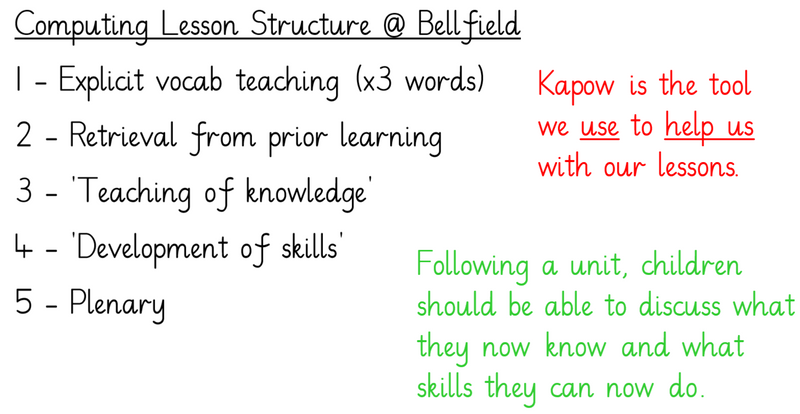
Due to the high percentage of disadvantaged children at Bellfield Junior School, at the beginning of each lesson, children are introduced and
taught a maximum of 3 key computing vocabulary words which they may not have encountered before, enabling all children to be able to access lessons and expand their computational knowledge.
All year groups will experience ‘Safer Internet Day’ during the year which will enhance their knowledge and global resilience online. This is
consolidated by following the ‘Education for a Connected World framework’ for e-safety lessons, with e-safety lessons preceding all other units every half term covering a variety of technological topics and issues. Each half term has an e-safety theme which each year group learn about with an inbuilt progression of lessons. This ensures that e-safety is dip fed throughout the year.
Children are encouraged to work deeper and extend their knowledge in computing when it is evident that they have mastered what is currently
being asked of them – be it for a particular lesson or for that particular unit. This is encouraged through challenging the children via
collaboration, letting them discuss and present ideas, considering other points of view and making decisions in order to increase their stakes in
their own learning. Through higher order skills, such as creating, evaluating and analysing, children can work deeper in a more meaningful,
personal and relevant way. All units and lessons adapted from ‘Kapow Primary’ have detailed explanations on all lesson plans describing to teachers how they can push their more able children on to working at a greater depth within the lesson. Mixed ability seating and the sequencing of lessons as part of a spiral curriculum all contribute to pushing our children to work at a deeper level within computing. Children who show a talent, flair or interest in computing are provided the opportunity to work deeper within a computing after school club, ran by the computing lead.
Staff development
For computing, staff development is achieved through internal training, where staff can be informed and enhance their knowledge of the computing curriculum as a collective, led by either the computing lead or an external practitioner. Furthermore, staff are encouraged to query and discuss computing knowledge, skills and progression with the computing lead as and when they need to develop their subject knowledge, often about units of work that they are about to undertake in their year groups. Use of Kapow Primary also provides an in-built CPD for staff to enable them to learn as they plan and develop subject knowledge through bite-sized videos with rich, visual demonstrations of proven techniques developed in the classroom by top specialists.
Assessment
Assessment in computing is aided through end of unit quizzes that enable teachers to make accurate end of unit assessments. The quizzes question children about their knowledge and skills of the unit they have just completed, as well as questioning them on previous units to assess what they are accessing from their long-term memory. End of unit quizzes are multiple choice, which enables those children who need extra support to access and show a true reflection of what they have learned in computing, not being held back by their progress in English. The last question of each quiz is open ended, which allows those children working at a greater depth to show their deeper level of understanding and learning.
Curriculum Matrix
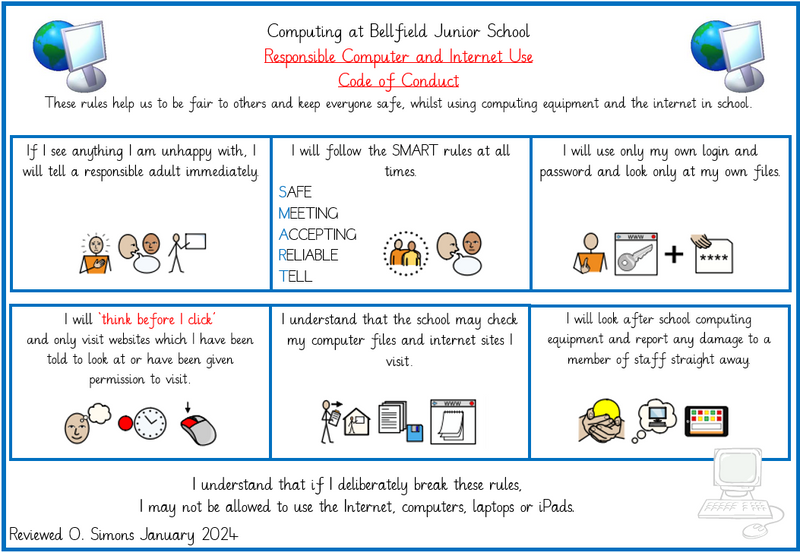
Code of Conduct
Online Safety
At Bellfield Junior School, we use the Education for a Connected World framework to help equip our children for a digital life. Read more about the framework below.

Adaptive Teaching
YEAR 3!
Take a look at some of Year 3's computing learning...
YEAR 4!
Take a look at some of Year 4's computing learning...
YEAR 5!
Take a look at some of Year 5's computing learning...

YEAR 6!
Take a look at some of Year 6's computing learning...
KIDS ZONE!
Scratch
On Scratch, you can do tons! You can make apps, animations and games. This is the newest version, Scratch 3, so it’s even more powerful than before!
Scratch Jr
This is Scratch for younger children. It uses nice, easy buttons to make simple games and animations.
Blockly
Blockly is similar to Scratch, it’s also free to use!
TinkerCAD
All kinds of making - including 3D with TinkerCAD.
BBC Bitesize
Loads of fun and interactive learning all about Computing across a range of topics.
https://www.bbc.co.uk/bitesize/subjects/zvnrq6f
Learn to Code
Lots of online courses to learn more about coding and even code and create your own games!
https://studio.code.org/courses
Dance Mat Typing
When you can do it well, touch typing is the fastest way to write. Many people quickly learn to touch type faster than they can write with a pen. How fast can you type?
YEAR 6 LESSON
DOWNLOAD SPREADSHEET BELOW
| Name | Format | ||
|---|---|---|---|
| Files | |||
| counts-entries-10-weekday-sample-2-.csv | .csv | ||


